
New federal data ranks every reporting state by maternal mortality rate. The findings should concern every Pennsylvania family expecting a child.
In 2021, 42 people died from pregnancy-related causes in Pennsylvania. When the state's own Maternal Mortality Review Committee reviewed those deaths, it found that 41 of them, or 98 percent, were preventable. That conclusion, published in the Pennsylvania Department of Health's 2025 annual report, is the most important thing to understand about maternal mortality in this state: having a below-average death rate does not mean the problem is solved. It means Pennsylvania is still losing mothers who should have come home.
To understand the full scope of that crisis, Harden Crichton, P.C. examined the most recent state-level data from the Centers for Disease Control and Prevention, which ranks all 39 states with statistically reliable maternal mortality figures for the 2018 to 2022 period. What that data shows is a country deeply divided by geography, and a national failure to treat preventable maternal death as the emergency it is.
Which States Have the Highest Maternal Mortality Rates?
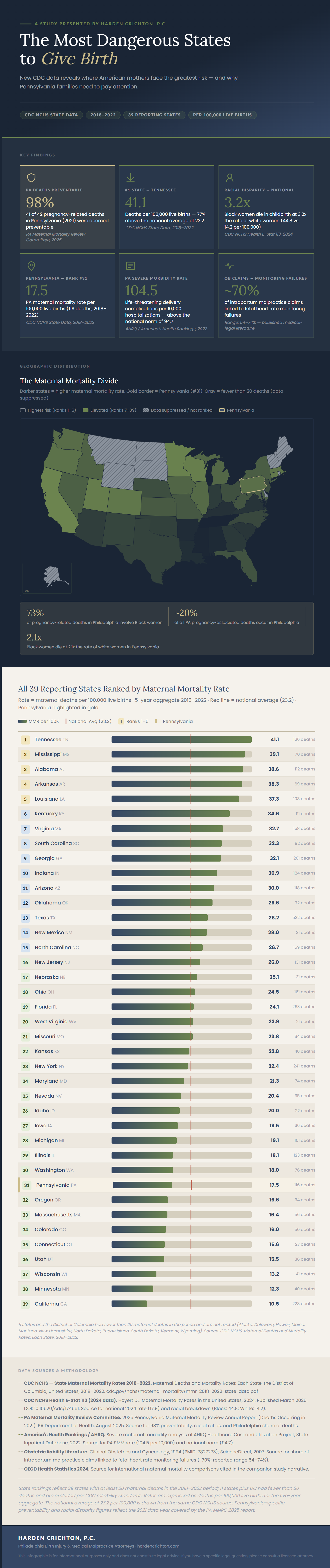
The data is stark. Tennessee recorded the highest maternal mortality rate in the country for the 2018 to 2022 period at 41.1 deaths per 100,000 live births, 77 percent above the national average of 23.2 for the same period. That figure is not a statistical outlier. It reflects 166 women who died over five years in a single state, at a rate that puts Tennessee in a category of its own.
Behind Tennessee, the next four states round out what the data shows is a concentrated crisis in the South and lower Midwest. Mississippi recorded 39.1 deaths per 100,000; Alabama, 38.6; Arkansas, 38.3; and Louisiana, 37.3. Every one of those states exceeded the national average by more than 60 percent. Together, they represent a region where giving birth carries a risk dramatically higher than what women elsewhere in the country face.
At the other end of the spectrum, California recorded the lowest rate among all 39 reporting states at 10.5 deaths per 100,000 live births, roughly a quarter of Tennessee's rate for the same period. That gap, between the best and worst state outcomes in the same country during the same five-year window, is not explained by differences in how maternal mortality is defined or counted. It reflects real differences in healthcare access, quality of obstetric care, hospital policies, and systemic investment in maternal health.
Copy and paste the HTML code below to share our infographic on your website.
<a href="https://www.hardencrichton.com/research-studies/which-states-are-most-dangerous-to-give-birth-in/">
  <img src="https://cdn.sanity.io/images/vr03kfhi/production/46670a1dadbb9dde533f1e9aa97bd5a3f6a3111f-1500x7127.png" alt="The Most Dangerous States to Give Birth, a study by Harden Crichton, P.C." title="The Most Dangerous States to Give Birth">
</a>
<br>
<a href="https://www.hardencrichton.com" title="hardencrichton.com">By hardencrichton.com</a>| Rank | State | Deaths per 100,000 live births | Total maternal deaths (2018–2022) | vs. national average (23.2) |
|---|---|---|---|---|
| 1 | Tennessee | 41.1 | 166 | +77% |
| 2 | Mississippi | 39.1 | 70 | +69% |
| 3 | Alabama | 38.6 | 112 | +66% |
| 4 | Arkansas | 38.3 | 69 | +65% |
| 5 | Louisiana | 37.3 | 108 | +61% |
| 6 | Kentucky | 34.6 | 91 | +49% |
| 7 | Virginia | 32.7 | 158 | +41% |
| 8 | South Carolina | 32.3 | 92 | +39% |
| 9 | Georgia | 32.1 | 201 | +38% |
| 10 | Indiana | 30.9 | 124 | +33% |
| 11 | Arizona | 30.0 | 118 | +29% |
| 12 | Oklahoma | 29.6 | 72 | +28% |
| 13 | Texas | 28.2 | 532 | +22% |
| 14 | New Mexico | 28.0 | 31 | +21% |
| 15 | North Carolina | 26.7 | 159 | +15% |
| 16 | New Jersey | 26.0 | 131 | +12% |
| 17 | Nebraska | 25.1 | 31 | +8% |
| 18 | Ohio | 24.5 | 161 | +6% |
| 19 | Florida | 24.1 | 263 | +4% |
| 20 | West Virginia | 23.9 | 21 | +3% |
| 21 | Missouri | 23.8 | 84 | +3% |
| 22 | Kansas | 22.8 | 40 | -2% |
| 23 | New York | 22.4 | 241 | -3% |
| 24 | Maryland | 21.3 | 74 | -8% |
| 25 | Nevada | 20.4 | 35 | -12% |
| 26 | Idaho | 20.0 | 22 | -14% |
| 27 | Iowa | 19.5 | 36 | -16% |
| 28 | Michigan | 19.1 | 101 | -18% |
| 29 | Illinois | 18.1 | 123 | -22% |
| 30 | Washington | 18.0 | 76 | -22% |
| 31 | Pennsylvania | 17.5 | 116 | -25% |
| 32 | Oregon | 16.6 | 34 | -28% |
| 33 | Massachusetts | 16.4 | 56 | -29% |
| 34 | Colorado | 16.0 | 50 | -31% |
| 35 | Connecticut | 15.6 | 27 | -33% |
| 36 | Utah | 15.5 | 36 | -33% |
| 37 | Wisconsin | 13.2 | 41 | -43% |
| 38 | Minnesota | 12.3 | 40 | -47% |
| 39 | California | 10.5 | 228 | -55% |
Where Does Pennsylvania Stand?
Pennsylvania ranked 31st out of 39 reporting states, with a maternal mortality rate of 17.5 deaths per 100,000 live births and 116 total maternal deaths over the five years. These two figures count different things: the CDC's state table counts deaths within 42 days of the end of pregnancy using death-certificate coding, while Pennsylvania's review committee examines pregnancy-related deaths up to a full year afterward through case-by-case review, which is why a single year of committee review can identify 42 deaths. That rate is below the national average of 23.2, which may look reassuring on paper.
The 98 percent preventability figure puts it in context.
Pennsylvania's Maternal Mortality Review Committee (a panel of clinicians, public health experts, and community advocates that reviews each death on a case-by-case basis) concluded that 41 of the 42 pregnancy-related deaths it reviewed for 2021 were preventable. That is not a finding about rare or extreme circumstances. It is a clinical determination that, in nearly every case, the outcome could have been different with appropriate care.
Pennsylvania also records a severe maternal morbidity rate of 104.5 per 10,000 delivery hospitalizations, meaning life-threatening complications during delivery are occurring at elevated rates even when deaths are avoided. For families in Philadelphia, Delaware County, and Montgomery County, these numbers are not abstract. They describe what is happening in hospitals across this state every year.
Why Are Black Women Dying at Such a Disproportionate Rate?
The racial disparity in maternal mortality is one of the most documented and least resolved public health failures in the United States. Nationally, Black women die from pregnancy-related causes at 3.2 times the rate of white women, according to the most recent CDC data. That gap persists across income levels, education levels, and insurance status. It is not explained by individual risk factors. It reflects a documented pattern of unequal treatment inside the healthcare system itself.
In Philadelphia, the data is especially pointed. Non-Hispanic Black women represent a significant majority of pregnancy-related deaths in the city, a pattern that mirrors what happens in urban centers across the country where racial health inequities are concentrated and compounded.
These disparities are not new, and they are not hidden. They have been documented by the CDC, by state review committees, and by local public health authorities for years. What continues to be missing is accountability: the recognition that a preventable death is not a medical mystery but a system-level failure, and that families who have lost a loved one to that failure have legal rights worth understanding.
What Does Obstetric Malpractice Have to Do With Maternal Mortality?
Not every maternal death involves malpractice. But the connection between preventable maternal outcomes and failures in clinical care is a consistent thread through both the public health data and the medical malpractice record.
Research on closed obstetric liability claims shows that approximately 70 percent of intrapartum malpractice claims (those arising from what happens during labor and delivery) are linked to failures in fetal heart rate monitoring. When warning signs on a fetal monitor are missed, ignored, or misread, the consequences can be catastrophic and irreversible.
Beyond monitoring failures, the most common allegations in obstetric claims involve delays in recognizing and treating fetal distress, errors in how vaginal deliveries are performed, and failures in managing high-risk pregnancies. Together, these three categories account for 59 percent of obstetric claims, nearly six in ten.
Pennsylvania's 98 percent preventability finding is consistent with what medical malpractice attorneys see in practice. When a clinical review committee examines a maternal death and concludes it was preventable, it is making a judgment that something in the standard of care fell short, which is precisely the standard that governs a medical malpractice claim.
What Should Pennsylvania Families Know?
If you are pregnant, planning a pregnancy, or have recently given birth in Pennsylvania, the data in this analysis is relevant to your family. It does not mean that every hospital in the state is dangerous, or that every complication is the result of negligence. It does mean that Pennsylvania's own clinical reviewers have concluded that the overwhelming majority of pregnancy-related deaths in this state did not have to happen.
If your family has lost a mother, wife, or partner to a pregnancy-related complication in Pennsylvania, or if you or someone you love experienced a serious injury during delivery, you may have legal rights that deserve to be understood. Medical malpractice claims involving maternal death or birth injury are among the most complex cases in personal injury law. They require attorneys who understand obstetric medicine, who know how to work with medical experts, and who are prepared to take on the hospitals, insurers, and healthcare systems that caused the harm.
Harden Crichton, P.C. is a Philadelphia birth injury and medical malpractice law firm that represents families throughout Pennsylvania, including Philadelphia, Delaware County, Montgomery County, Chester County, and the surrounding region. The firm has recovered over $100 million for injured clients and handles every case on a contingency fee basis, meaning there are no upfront fees and no legal costs unless compensation is secured.
If you believe a loved one's death or injury during pregnancy was preventable, call Harden Crichton, P.C. at 215-798-7341 or complete the online contact form to schedule a free, confidential consultation. The firm will listen to what happened, explain your options, and tell you honestly whether a claim is worth pursuing.
Sources and Methodology
State-level maternal mortality rankings are drawn from the CDC National Center for Health Statistics, "Maternal Deaths and Mortality Rates: Each State, the District of Columbia, United States, 2018-2022." Rates are deaths per 100,000 live births for the five-year aggregate. Only states with at least 20 maternal deaths in the period are included; 11 states plus DC have suppressed data. The national average of 23.2 per 100,000 applies to this 2018-2022 period and comes from the same source.
The national maternal mortality rate of 17.9 for 2024 is from CDC NCHS, Hoyert DL, "Maternal Mortality Rates in the United States, 2024," NCHS Health E-Stat 113, published March 2026.
The 98 percent preventability figure and severe maternal morbidity rate of 104.5 per 10,000 are from the 2025 Pennsylvania Maternal Mortality Review Committee Annual Report (deaths occurring in 2021), published by the Pennsylvania Department of Health in August 2025, and from America's Health Rankings analysis of AHRQ Healthcare Cost and Utilization Project data (2022), respectively.
The 3.2 times racial disparity figure and the approximately 70 percent fetal monitoring connection are drawn from CDC NCHS Health E-Stat 113 (2024 data) and from obstetric liability research published in Clinical Obstetrics and Gynecology (1994) and ScienceDirect (2007). The 59 percent figure for the three leading allegation categories is from MDedge / OBG Management, "A survey of liability claims against obstetric providers," an analysis of 882 obstetric claims closed between 2007 and 2014.
Disclaimer: This article is for informational purposes only and does not establish an attorney-client relationship or constitute legal advice. For guidance specific to your situation, please contact our team directly.